1. Blog
  2. Article

Amrisha Prashar
on 4 February 2016
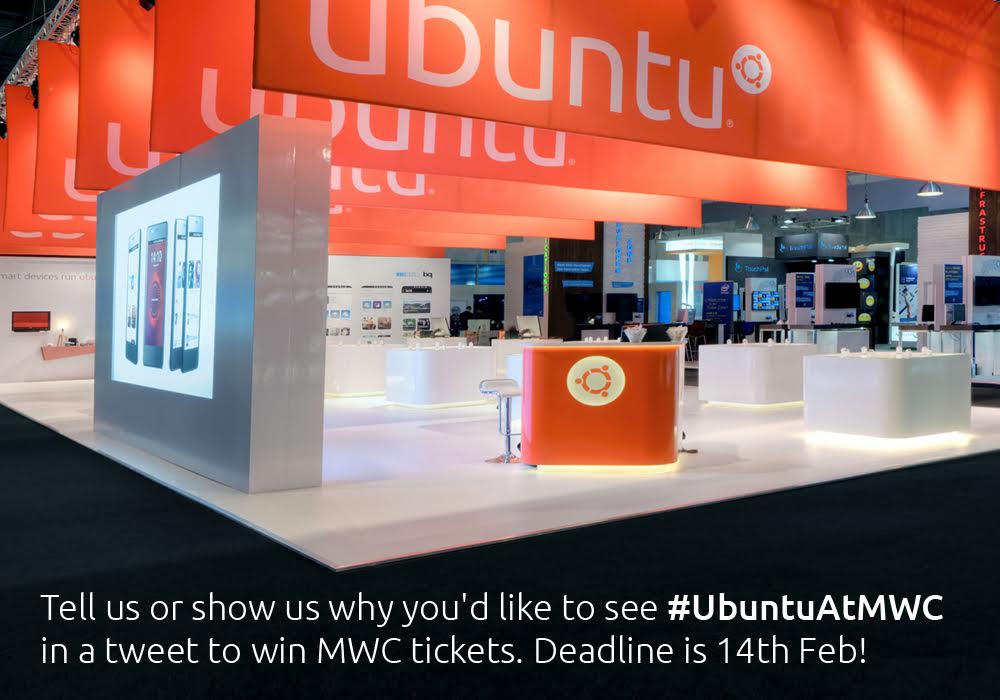
#UbuntuAtMWC Competition


We’re really excited about MWC this year and can’t wait to showcase the various demos across Cloud and Devices!

For those of you not going we’d love to offer you the chance to come and join us and see what we have on display – as our presence is even bigger and better than last year.

To win tickets to MWC we’d like you to tell us or show us why you want to see Ubuntu at MWC in a tweet! Feel free to be as creative as possible with text, images, GIFs or even videos and add the hashtag #UbuntuAtMWC so we can track your awesome entries. The competition starts on 4th Feb (17:00 GMT) and finishes just before the stroke of midnight on Valentines day – 14th Feb (23:55 GMT.) Our creative team will judge the entries based on originality and select three winners where we’ll contact you via Twitter.

Happy creating and we can’t wait for your entries!
Terms and Conditions #UbuntuAtMWC

Related posts


David Beamonte
14 July 2026

MAAS installation: bare metal provisioning is easier than ever

MAAS Ubuntu tech blog

MAAS brings cloud-like automation to physical servers. It helps teams discover, commission, deploy, and repurpose machines from a central control plane, turning bare metal into a programmable resource. But to experience that value, users first need to get MAAS up and running. That path is now cleaner and easier to follow. We’ve created ne ...


seth-arnold
11 July 2026

Januscape vulnerability CVE-2026-53359 mitigations available

Ubuntu Article

Introduction A local privilege escalation (LPE) vulnerability affecting the Linux kernel was publicly disclosed on July 6, 2026. The vulnerability was assigned CVE ID CVE-2026-53359 and is referred to as Januscape. This vulnerability affects all Ubuntu releases. Neither NVD nor Kernel.org have published their own CVSS scores for this issu ...


David Beamonte
9 July 2026

Managing Ubuntu on bare metal at scale

MAAS Ubuntu tech blog

Modern infrastructure teams are expected to deliver cloud-like speed, consistency, and reliability, even when their workloads run on physical servers. Bare metal remains essential for many environments: private clouds, Kubernetes clusters, AI infrastructure, edge sites, regulated platforms, and large Ubuntu estates. But operating physical ...